
Students Find the World in Their Carl Junction Classroom
Contributed by Doug Logan, Carl Junction High School History Teacher
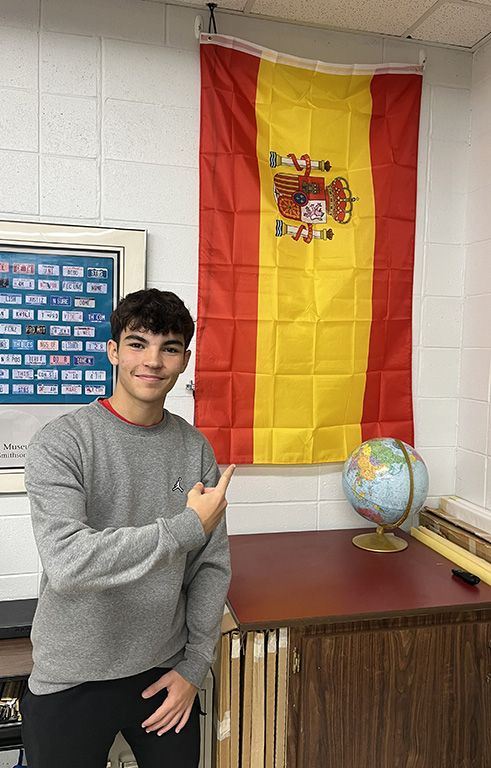
Because his Modern American History classes were studying the Spanish-American War, Doug Logan, a history teacher at Carl Junction (Missouri) High School, hung the flag of Spain in his classroom. When Juan Peña, an exchange student from Spain, walked into the classroom, his eyes lit up.
“That’s my flag!” he said to another student.
As their study of the war unfolded, students learned about battles in both the Caribbean and Pacific theaters. When the question of Puerto Rico arose, Jeriel Rodriguez Rivera, another student in Mr. Logan’s class, was there to provide answers.
“I’m from Puerto Rico,” he said. “I lived there for eight years before I moved away. We go back almost every two years to visit friends and family.”
“I couldn’t let this teachable moment slip away,” said Mr. Logan. “I asked the class, ‘If you go to Puerto Rico today, do you need a passport?’”
His students weren’t sure how to answer. As a result of the Treaty of Paris (1898), which officially brought an end to the Spanish-American War, Puerto Rico was ceded to the United States from Spain. It has been U.S. territory ever since, so no passport is required.

“What’s it like to find out some of your classmates don’t know Puerto Rico is part of the United States?” Mr. Logan asked Jeriel.
“It surprises me,” Jeriel said, “due to the fact that it’s a U.S. territory, but I don’t blame them (since it’s) not counted as a state.”
When Mr. Logan asked Jeriel if he had any pictures from his childhood in Puerto Rico, “he just beamed. He had some pictures on his phone from a childhood trip with his dad to El Morro, a well-known fortress in San Juan” that Mr. Logan projected onto the screen in the classroom. “Jeriel took over my class at that point. The kids were so interested in his experiences in Puerto Rico; I just stood back and watched.”
As their studies shifted to the Pacific theater, and students learned about the U.S. acquisition of Guam, another student, Jessaiah Solomon, chimed in.
“I’m from Guam,” he said.
“In 22 years of teaching,” Mr. Logan said, “this has never happened. Never have I had students from Spain, Puerto Rico and Guam in my classes while we’re studying an American conflict in which all three were involved.”

Jessaiah lived in Guam until he was 12 years old.
“People don’t even know what it is, but I’m not that surprised,” Jessaiah said as he pointed to its location on a map. “It’s a pretty small island; our biggest city is smaller than Joplin. It’s not that well-known to mainlanders.”
As students examined the provisions of the Treaty of Paris, “the most robust discussion we’ve ever had” about Puerto Rican and Guamanian statehood ensued, Mr. Logan said, with Jeriel and Jessaiah fielding most of the questions.
“Around 75% of Puerto Ricans want it to become a state,” Jeriel said, “but the other 25% don’t because they want independence and they believe in the republic.”
As for Guam, Jessaiah said, “I think they would like to become a state because they already pay U.S. taxes, so we might as well.”
Sitting in the same classroom was Eduardo Salema, an exchange student from Portugal.

“I think that a global perspective in a classroom is always a really positive addition,” Eduardo said. “Even when I was in Portugal, there were Ukrainian, Brazilian and Cape Verdean students that brought more awareness and different viewpoints. That helped me learn more as a student and citizen of the world.”
As a history teacher, Mr. Logan said, “I can’t not take advantage of these types of students who are sitting in my classroom, right here in Southwest Missouri.”
Eduardo said, “I love when I get to share my perspective as a European with the rest of the class, as well as hearing Missourians’ opinions and stances. I think this mutual understanding and exchanging of cultures is a very beneficial aspect of foreign exchange programs.”
“I enjoy presenting events in class that involve my country,” Juan added, “because I feel Spain has a very rich and interesting history, and I think it’s great that part of it is studied here. (Seeing his country’s flag on display) gave me the feeling of being back home and reminds me how different things are in the USA and Spain … it made me think about how much my lifestyle has changed in just three months.”
Alma Augustinussen, an exchange student from Denmark, is also in Mr. Logan’s class.

“I think it’s interesting to compare Europeans’ and Americans’ views on the same historical event,” Alma said. “It surprises me how little some American students know about other countries. I have been asked some really funny questions about Denmark!”
At the beginning of the school year, when President Trump’s comments about Greenland—a territory of Denmark—made headlines, “it sure was interesting to hear what Alma had to say,” Mr. Logan recalled.
“Just because we are a very small country, it doesn’t mean we haven’t done anything,” Alma explained. “When I hear Americans talking about annexing Greenland, it feels a bit strange because it is a part of Denmark. It’s a place that has a big meaning for us.”
Although he’s the teacher, Mr. Logan “always end up learning from folks from other parts of the country and other parts of the world. And if I’m learning from them, I know my students are, too. These kids are helping me teach history!”

