
Full Speed Ahead: Dr. Rick Miller’s Life on the Water
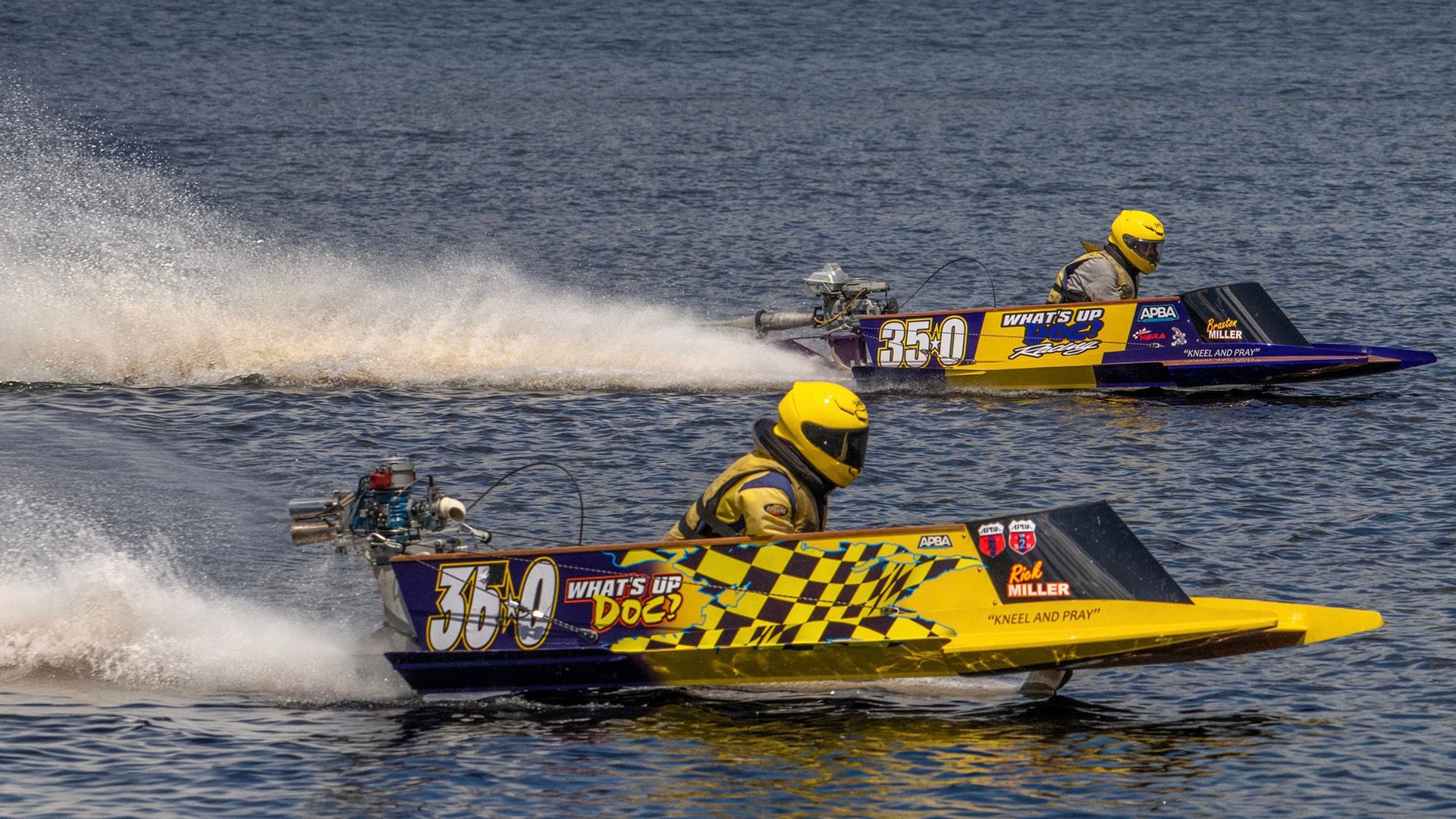
Long before Dr. Rick Miller became known around Grove, Oklahoma, as a trusted dentist, he was already learning what it meant to chase speed across the water.
Boat racing has been part of the Miller family story for more than seven decades. It started in 1953 when Dr. Miller’s grandfather and father first entered the sport. Although his father stepped away for several years while attending college and dental school, racing eventually found its way back into the family’s life. By 1970, a young Rick Miller was spending weekends at races, helping in the pits and dreaming about the day he could take the wheel himself.
“I always wanted to race as a little kid being pit crew for my father,” Dr. Miller said.
That dream became reality in 1978 when he officially started racing. Nearly 50 years later, he is still doing what he loves, now as one of the most recognizable names in hydroplane and runabout racing. Over the years, he has built an impressive résumé that includes more than 120 championship race wins and seven inductions into the American Power Boat Association Hall of Champions.
But for Dr. Miller, the story has never been just about trophies.
Racing has long been at the center of his family, his friendships and his life beyond the dental office. It is a legacy now stretching across four generations through the What’s Up Doc Racing Team, a name that has become familiar to racing fans across the country.
“It is pretty cool to have had four generations in the What’s Up Doc Racing Team,” he said. “Also racing since 1953 is pretty amazing as well.”
Today, that legacy continues with his nephew, Braxton, who started racing at just 10 years old in 2008. Braxton has already carved out an impressive path of his own with more than 70 championship wins and five APBA Hall of Champions inductions.
To spectators watching from the shoreline, boat racing often looks glamorous and thrilling. The boats skim across the surface at incredible speeds, engines roaring as drivers battle for position. What many people never see, however, is the demanding work that happens long before race day arrives.
“What they don’t know is how much work behind the scenes it takes to be successful,” Dr. Miller said. “Like anything in life, there is a lot of sweat and work that goes into working on the motors and maintenance to keep them running.”
The preparation is relentless.
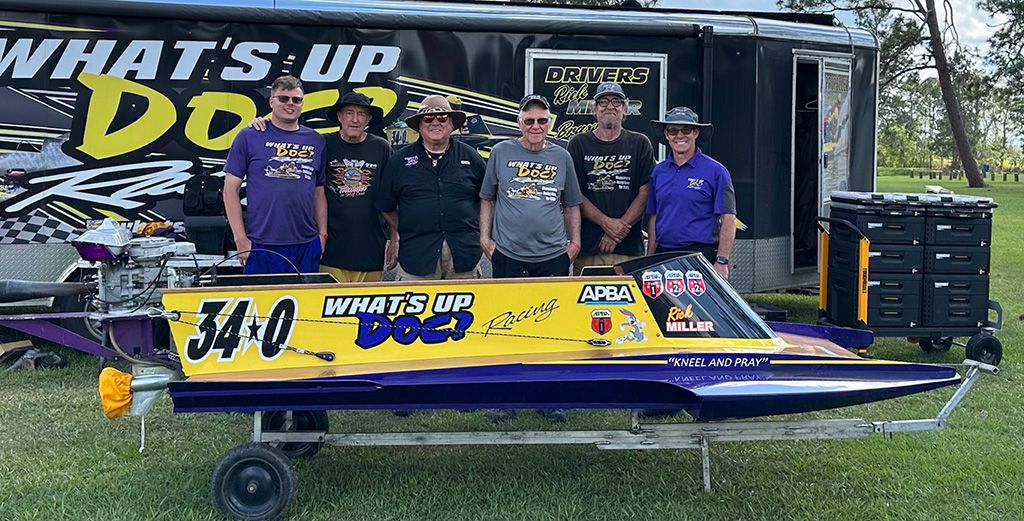
Most race weekends begin on Thursday evenings after work. Dr. Miller and his team pack up their equipment and hit the road, sometimes driving through the night to reach races across the country. What once stayed within a comfortable six-to-eight-hour radius has expanded dramatically over the years as the team follows APBA circuit events nationwide.
Their closest races are now often 10 hours away. They have traveled everywhere from Washington and New York to Florida and Georgia.
After arriving at a race site, the real work begins. Boats must be unloaded, motors mounted, cables and steering systems connected, and equipment tested before competition even starts.
“We may get there at 7-9 in the morning after driving all night,” Dr. Miller said. “Then we have to set up the dollies, get the boats off, put the motors on the boats and hook up all the cables and steering.”
Testing sessions are equally important. Drivers and crews spend hours adjusting setups and fine-tuning performance in search of even the slightest speed advantage.
Race weekends quickly become a blur of organized chaos.
“There are times when it is not so busy, then times when it is crazy busy,” he said.
And then there is the physical challenge of the boats themselves.
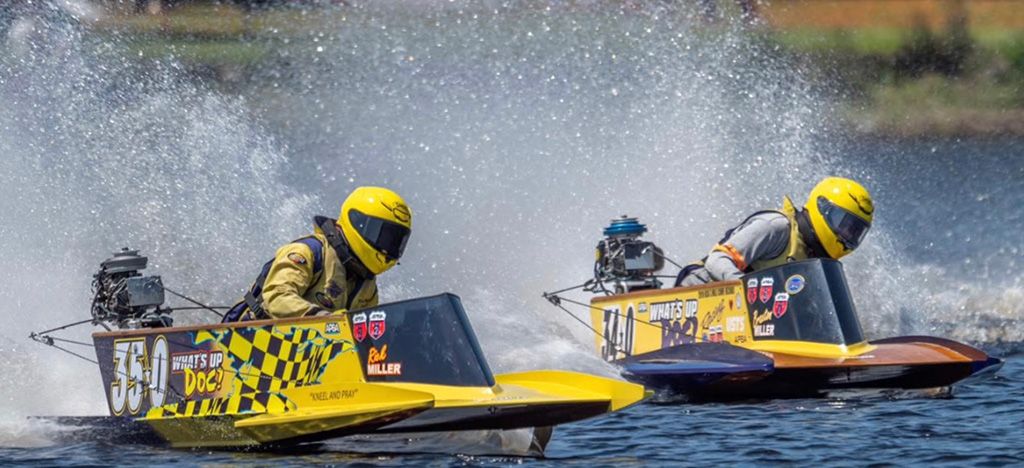
Dr. Miller races hydroplanes and runabouts in the Stock and Modified outboard divisions under both APBA and NBRA sanctioning bodies. Unlike many traditional race boats, these designs require drivers to race on their knees.
The unusual position is intentional.
“Our body helps control the attitude of the boat,” Dr. Miller explained.
The team has even embraced the challenge with a bit of humor. Every boat proudly displays the phrase “Kneel N Pray.”
“Definitely have to do this when racing,” he said.
Despite the humor, the dangers are very real.
Boat racing requires intense concentration and split-second decision making. Drivers must constantly balance aggression with caution while navigating changing water conditions and nearby competitors moving at high speeds.
“You have to respect the boat and conditions as well as the other racers,” Dr. Miller said. “There are times you can take risks and times you need to drive conservatively.”
One of the most critical moments comes before the race even officially begins. Drivers must carefully time their approach to the starting line during a three-minute countdown, attempting to cross at full speed exactly as the clock hits zero.
“Focus is extremely important especially on our starting process,” he said.
Even after decades in the sport, the competition still fuels him.
“Everyone thinks it’s the speed, but you kind of get used to the speed,” Dr. Miller said. “I just love to compete and try to win my class and be the national champion.”
That competitive mindset is impressive enough on its own, but what makes Dr. Miller’s story even more remarkable is how he balances racing with a demanding dental career.
By day, he cares for patients at Grove Dental Associates. By night, he often heads to his race shop to work on boats and equipment before returning home to tackle office administrative responsibilities.
“I usually go to my race shop after work and try to get in an hour or two of work,” he said.
Weekends without races are rarely restful.
Instead, they are spent maintaining equipment, preparing motors and getting ready for the next competition.
Dr. Miller is quick to credit the people around him who help keep everything running smoothly.
“I have others that help me, which I could not do it without them,” he said.
That appreciation for teamwork appears throughout every part of the Miller racing story. While Dr. Miller’s accomplishments are extraordinary, he consistently points to the countless builders, mechanics, pit crew members, friends and family members who have contributed to the team’s success over the years.
“We have had a lot of success, but this is really due to the amazing help we have had from boat builders, motor builders and many people who have gone to the races with us as pit crew to help us,” he said.
For Grove residents, one of the biggest highlights each year is seeing Dr. Miller compete close to home during the Grand Lake races. The hometown event carries extra excitement, but also extra pressure.
“So many of my patients and friends like to watch me race,” he said.
At the same time, Dr. Miller and his father are heavily involved in helping organize the race itself, creating an entirely different layer of responsibility behind the scenes.
“Trying to be in charge of putting on the race and race successfully is always tough,” he admitted.
Still, nothing compares to hearing the crowd respond after a hometown victory.
“There is nothing better than winning the race in Grove and getting lots of applause from our friends,” he said.
While championships and accolades are certainly part of Dr. Miller’s story, the deeper meaning behind racing becomes clear when he talks about the relationships it created throughout his life.
Over decades in the sport, the Miller family has formed friendships all across the country. Race weekends have become reunions, bringing together people connected by a shared passion for competition and life on the water.
“If you ask why racers race, most would say it is more of the relationships than it is the racing,” Dr. Miller said.
That sense of connection is perhaps what has kept the Miller family involved for so many years. Racing has allowed them to travel together, work together, compete together and continue building memories generation after generation.
And through it all, Dr. Miller has remained deeply grounded in Grove, balancing his professional life, family life and racing career with humility and gratitude.
For many in town, he may always be the friendly dentist they know and trust. But once the helmet goes on and the engine fires to life, Dr. Rick Miller becomes something else entirely. He becomes part of a racing legacy more than 70 years in the making.
This June, as the hydroplanes once again roar across Grand Lake, fans will see the excitement and intensity that define the sport. What they may not immediately see are the decades of work, sacrifice, family tradition and determination powering every lap.
For Dr. Miller, that journey started as a little boy in the pits, watching his father race and dreaming of one day doing the same.
Nearly five decades later, he is still chasing the next finish line.

